
Match each status to its dated agency record.
Pasquotank Commission Input and Discharge
The Commission’s victim process is separate from supervision reporting and from any public parole calendar. The official victim guide says meetings are held weekly, last 30 minutes, and are limited to five people. A meeting should be requested at least four months, but no earlier than one year, before release. It allows eligible participants to provide information for Commission review. It is not an offender hearing, does not put a release date on a public docket, and does not replace the Commission’s formal decision record.
The North Carolina Commission reviews eligible parole cases without meeting personally with the offender. Four commissioners serve, and a majority must agree. An “Incomplete Decision” in the monthly report means more information is needed or a MAPP investigation may be considered. “Suspend Decision” means further consideration stopped at that time. Neither term should be restated as a grant, denial, or scheduled release. Regular Parole, Community Service Parole, Early Medical Release, and 90-Day Mandatory Parole also describe different legal outcomes.
Discharge requires the same care. Release from Pasquotank Correctional Institution can start post-release supervision, while final discharge ends the remaining sentence obligation. A probation case may terminate through the court and DAC record. A parole case may end under the older-law authority that governs it. If OPI shows a release event but no clear termination, request the existing supervision start and termination entries from DAC. Commission contact is 2020 Yonkers Road, 4222 Mail Service Center, Raleigh, NC 27699-4222; 919-716-3010; Parole.Commission@dac.nc.gov. That office handles Commission process, not a supervisee’s personal reporting directions.
Pasquotank Supervision Terms Defined
North Carolina uses three terms that are often blurred. Probation is a court-ordered sentence served in the community, often instead of an active prison term. Parole is conditional release available mainly in older-law cases. Post-release supervision, or PRS, follows prison for most people sentenced under modern Structured Sentencing. The Post-Release Supervision and Parole Commission sets PRS conditions and decides eligible parole matters.
Structured Sentencing took effect for covered offenses in 1994 and largely ended discretionary parole. That does not make every person who leaves Pasquotank Correctional Institution a parolee. The person may begin PRS, reach sentence expiration, transfer, or leave under another lawful status. Read the named event, not a broad label.
- Discharge
- The end of the sentence or supervision obligation shown by the responsible agency.
- Absconder
- A person alleged to have stopped required contact with supervision. It is not a new conviction.
- Revocation
- An official decision returning a supervisee to custody after a violation process.
- Detainer
- A request or hold from another authority that may affect custody or movement.
Parole and Probation Compared
Use the judgment and DAC event history together. The source of authority, starting point, and ending record differ.
| Status | How it begins | Best verification |
|---|---|---|
| Probation | A court places the person under community supervision. | eCourts judgment plus NCDAC OPI. |
| Parole | The Commission conditionally releases an eligible older-law prisoner. | OPI event history and Commission information. |
| Post-release supervision | A Structured Sentencing prisoner leaves prison for a required community phase. | OPI status, release event, and DAC Community Supervision. |
| Discharged | The sentence or supervision term ends. | Termination event or official DAC record. |
A prison release date and discharge date may therefore differ. Under Article 84A, physical release can start supervision while the sentence remains active. The Pasquotank County release-record search helps distinguish a jail departure from a later state supervision event.
Verify Pasquotank Post-Release Supervision
Start with the NCDAC Offender Public Information search. OPI covers state prisoners, probationers, and parolees, but not the Albemarle District Jail roster. A full name can produce several records, so an offender number is the strongest match.
- Search the exact name and offender number when known. Use age and other offered fields only to separate similar records.
- Open the matching record. Compare aliases, offense data, prison history, and the supervision event.
- Record the exact status and the date checked. “Active,” “terminated,” “absconded,” and “incarcerated” are not interchangeable.
- Review the Pasquotank eCourts case when the judgment or probation order matters.
- Use the Community Supervision office directory for the current District 1 contact. Give staff the offender number and ask what public status can be confirmed.
Do not use an office address as a place to find the person. Reporting directions are private case instructions that DAC gives to the supervisee. When records conflict, ask which event is newest and whether supervision transferred to another district or state.
Pasquotank Absconder and Transfer Records
NCDAC’s criminal offender searches landing page links an absconder tool and the Interstate Compact Offender Tracking Search. An absconder notation alleges missed supervision contact. It should not be restated as proof of a fresh offense. In covered victim-notification matters, G.S. 15A-837 calls for notice of absconding and capture within 72 hours.
Interstate Compact data applies when probation or parole supervision moves between states. It is not a travel log. A Pasquotank County record may remain tied to North Carolina while another state performs day-to-day supervision. Verify the record identity, receiving state, and current event with DAC rather than assuming a missing local office assignment means supervision ended.
Note: An absconder listing alleges lost supervision contact; it does not prove a new conviction or show that Pasquotank custody resumed.
Pasquotank Supervision Length and Discharge
For many Structured Sentencing felonies, G.S. 15A-1368.2 provides twelve months of PRS for Class B1 through E felonies and nine months for Class F through I felonies. A five-year framework applies to covered offenses requiring registration. Offense date and later amendments matter. The same statute permits an earned-time reduction during supervision, capped at 20 percent of the original period. These are legal frameworks, not a calculator for one person.
Conditions can include reporting, lawful conduct, approved residence or travel, and program duties set for the case. An alleged breach may prompt added controls, arrest, or a revocation process. It does not erase the need for an official decision. Completion under the statute terminates the sentence. Confirm that endpoint through the termination event or a focused DAC records request, not from a stale screenshot.
North Carolina Department of Adult Correction
Community Supervision, District 1 directory
Central office: 214 W Jones Street, Raleigh, NC
919-733-2126
DAC public-record request channel
Pasquotank Parole Review Records
North Carolina does not hold conventional public future parole hearings where an offender appears before the Commission. The Commission reviews eligible cases individually, and a majority of its four members must agree. Most modern Structured Sentencing cases are not eligible for discretionary parole. Older Pre-Fair and Fair Sentencing cases, specified exceptions, and certain juvenile life-with-parole cases require review of the judgment and offense date.
The public Monthly Discretionary Parole Reviews page offers retrospective month-by-month reports beginning in September 2024. As checked in the research, reports ran through June 2026. They are results reports, not an appointment calendar or a full case file. Terms include Regular Parole, Community Service Parole, Early Medical Release, 90-Day Mandatory Parole, Incomplete Decision, and Suspend Decision.
The official source shows how the monthly records and decision terms are arranged:
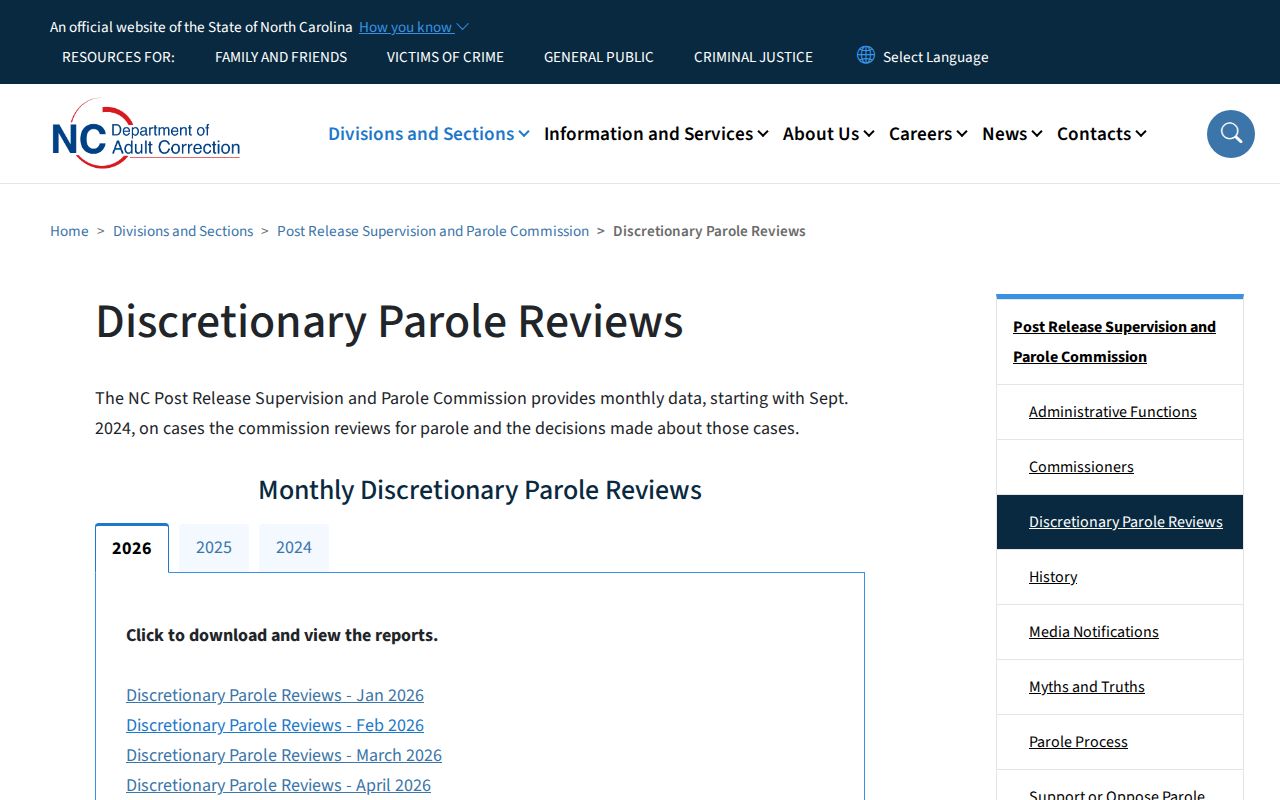
Use a listed decision as one dated part of the record. Commission deliberations and individual files remain confidential except for authorized disclosures.
Pasquotank Notification Status Checks
NC SAVAN is North Carolina’s statewide custody and supervision notification service. It covers participating county jail records, state prisoners, probationers, parolees, and registered offenders. The public interface is VINELink North Carolina, and the statewide help number is 1-877-627-2826. Search one exact person and compare the record identifier, agency, age details, and displayed update time before relying on a status.
A notification is a prompt to verify, not a discharge certificate. Agency feeds can lag, and the word “release” may describe a custody change that needs more context. Ask whether the event was release into the community, transfer, revocation movement, or the start of another custody term. A missing match may result from spelling, aliases, a system transfer, or record rules.
Registration is tied to the selected person and offered event. It does not follow every future case under the same name. If supervision moves interstate or a new custody record is created, confirm whether a new registration is needed. Keep notification contact details and telephone PINs private.
Note: A VINE alert reports a feed event, while DAC supplies the official supervision record needed to confirm its meaning.
Release Support Through G.R.A.C.E.
Beloved Haven’s G.R.A.C.E. program provides weekly trauma-informed outreach for women at Albemarle District Jail. It also describes continued services or referrals after release for people within its program scope. That creates a real Pasquotank-area reentry path alongside formal supervision.
G.R.A.C.E. is not a universal benefit, a supervision office, or a custody-status source. Participation does not prove release, parole, or probation. Use it as a local navigation option, while official status remains with NCDAC, the Commission, the court, or the jail record.
Note: G.R.A.C.E. offers support within its mission, but participation never verifies parole, probation, discharge, or release status.