
Record the source, date checked, and exact release-date label before comparing results.
Audit Pasquotank Custody Credits
Prior-confinement credit needs its own line in a release-date audit. Under G.S. 15-196.1, qualifying confinement tied to the charge is credited toward the minimum and maximum terms, subject to statutory limits. It is not an earned-time award for conduct or programs. It may also be unavailable when the same time was already credited to another sentence. Compare the judgment’s credit figure with every amended judgment and the agency’s current calculation rather than adding days from a booking history by hand.
For multiple Pasquotank judgments, mark each term as concurrent or consecutive. Concurrent terms overlap; consecutive terms run one after another. Then list the sentence start, judicial minimum, maximum, credited pretrial days, and the date of each order. A resentencing, appeal order, corrected credit, or changed sentence structure can make an older OPI projection obsolete even though that screenshot was accurate when captured. The current signed order and current DAC calculation control.
Legacy parole cases require a separate branch. Offenses under older Pre-Fair or Fair Sentencing law may use parole eligibility formulas plus good or gain time. G.S. 15A-1371 contains legacy rules, including minimum-term and one-fifth calculations and special provisions for some DWI or community-service parole cases. These are gateways, not a universal formula. The offense date, judgment, exceptions, and Commission action must all match the person.
Finish the audit by naming the expected event. Sentence expiration means full service with no PRS report requirement. Release to PRS means the person leaves prison while the sentence continues in the community. Parole, court-ordered release, transfer to a sheriff, pardon, and interstate transfer have still different effects. Ask DAC whether the displayed date is the physical exit, PRS start, maximum expiration, or another milestone. This one question prevents a correct number from being given the wrong meaning.
Pasquotank Projected Versus Actual Release
A projected release date is an agency calculation based on the sentence and facts known at that time. It can mark an expected prison exit, a maximum sentence date, a PRS start, or another administrative point. An actual release record documents what occurred. Its date, time, type, authority, and destination can show whether the person entered the community or moved to another agency.
Pretrial detention works differently. A person at Albemarle District Jail who has not been sentenced has no good-time-based release schedule. Bond, a court order, dismissal, or later judgment controls. Even after a judge enters an order, jail processing can take time.
Find a Pasquotank Release Date
The correct route follows custody. NCDAC’s Offender Public Information system covers state prison and community supervision records. It expressly excludes county jail information. A local booking at ADJ instead requires the jail, the judgment, and the Pasquotank clerk.
- Identify custody. Separate pretrial ADJ custody, a locally served misdemeanor, a DAC felony sentence, and a legacy parole case.
- Find the judgment. Use eCourts Portal to locate the case, then obtain the signed judgment and amendments from the clerk.
- Search state records. For a state prisoner, use NCDAC OPI by exact name or offender number. Record the displayed label and retrieval date.
- Compare fields. Check sentence start, minimum and maximum terms, jail credit, concurrent or consecutive terms, and the release type.
- Confirm locally. For an ADJ sentence, call 252-335-4844 and ask which unit can confirm the jail’s official calculation.
- Verify change. If dates differ, request the current calculation or existing release record from the responsible custodian.
The Pasquotank released-inmate search provides the wider path when custody itself is uncertain.
Read Pasquotank OPI Date Fields
OPI may show offender status, prison and admission history, sentence entries, supervision history, and projected or actual release information. A result must be matched carefully. The same name can belong to more than one person, and a local booking number is not a DAC offender number.
| Field | Why it matters |
|---|---|
| Offender number | Links the date to the correct DAC record. |
| Sentence start | Sets the calculation’s starting point. |
| Minimum and maximum | Define the Structured Sentencing range. |
| Prior-confinement credit | Credits qualifying time already held on the charge. |
| Projected date label | Identifies the milestone DAC is displaying. |
| Supervision event | Shows whether prison exit began PRS rather than full discharge. |
The official search form illustrates the name and identifier route:
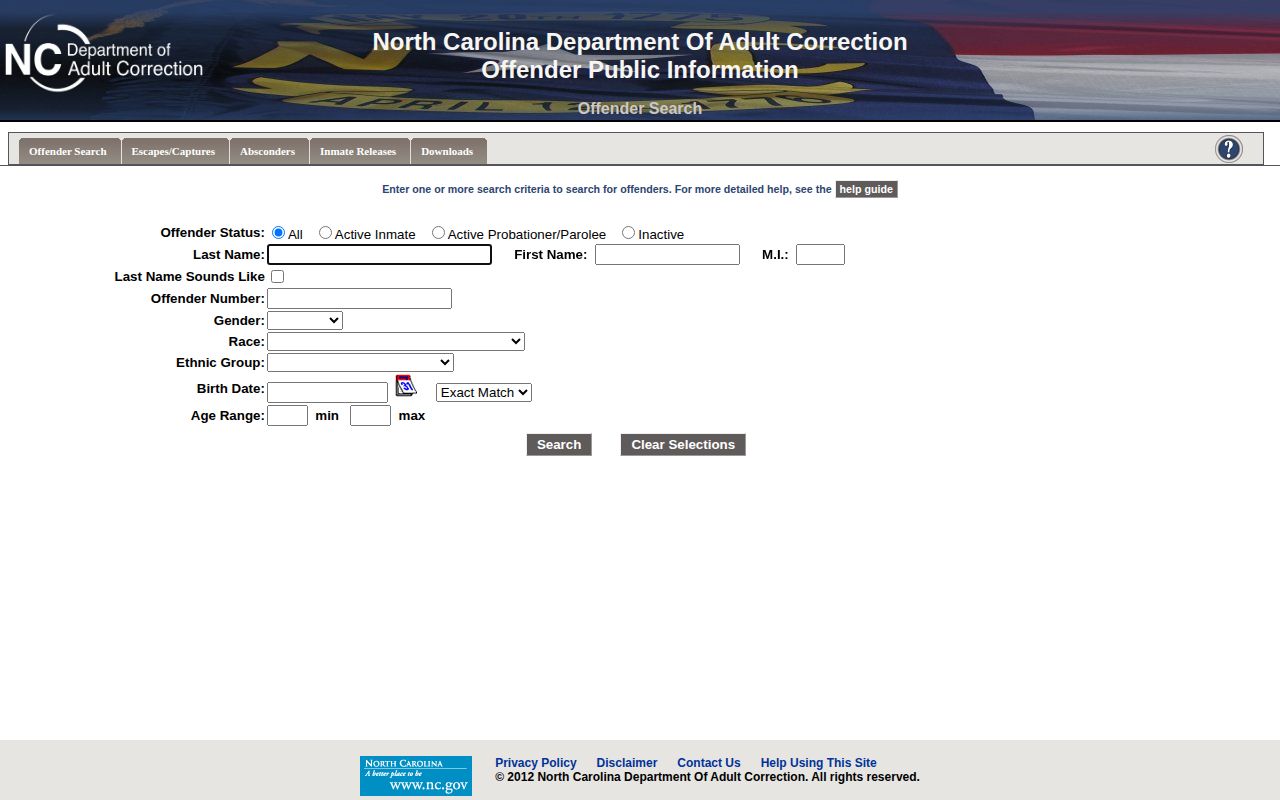
Save the field name, not just the number. “Maximum,” “projected,” “release to PRS,” and “discharge” answer different questions.
North Carolina’s Minimum-Term Rule
North Carolina has no general rule that every state prisoner serves about 85 percent. Under Structured Sentencing, an eligible felon serves 100 percent of the judicial minimum. G.S. 15A-1340.13(d) allows earned time to reduce the maximum toward the minimum, but never below that minimum. This is the central rule for a Pasquotank state-prison projection.
Earned time is credit awarded under correctional rules for qualifying conduct, work, or programs. It is not the same as prior-confinement credit. G.S. 15-196.1 credits qualifying confinement arising from the charge, subject to limits such as time already applied elsewhere. G.S. 148-13 directs DAC to set earned-time rules and distribute applicable regulations to local jail administrators.
For misdemeanors, G.S. 15A-1340.20(d) caps earned time at four days per month. That is a ceiling, not an automatic award. The judgment, credit, conduct, and jail’s calculation still control.
Why Pasquotank Release Dates Move
A sound comparison begins with two dated official records. A change does not by itself show an error or misconduct.
| Factor | Possible effect | Confirm with |
|---|---|---|
| Earned time | Gain or loss can move the maximum-side calculation. | DAC or jail calculation. |
| Discipline or program change | May alter credit already expected. | Current correctional record. |
| Corrected jail credit | Changes qualifying prior-custody days. | Judgment and agency computation. |
| Resentencing or appeal | An amended court order can replace the prior terms. | Pasquotank clerk file. |
| Concurrent or consecutive terms | Controls whether terms overlap or follow one another. | Signed judgments. |
| Detainer or transfer | May change destination without changing sentence service. | Holding and receiving agencies. |
A detainer is another authority’s request or hold. It may mean a scheduled departure from DAC or ADJ becomes a transfer, not community release. Ask for the expected exit type as well as the date.
Pasquotank PRS and Max-Out Dates
NCDAC Policy Q.0100 describes sentence expiration as complete service with no duty to report to parole or PRS, often called “max out” or PRD. Yet many Structured Sentencing prisoners leave the prison before maximum expiration to begin PRS under Article 84A. Ordinary eligible cases use a framework tied to the maximum less an applicable nine or twelve months, with a different five-year framework for covered reportable offenses.
Thus the physical exit can begin a supervised phase. It does not end the sentence. The separate Post-Release Supervision record should be checked when an OPI result shows a prison release but no final discharge.
Note: A prison exit into PRS is a release event, not the maximum expiration or final sentence discharge.
Audit Pasquotank Date Calculations
List each minimum, maximum, offense date, sentence start, and credited day from the signed judgment. Mark terms as concurrent, meaning served at the same time, or consecutive, meaning one follows another. Next record the exact OPI fields and date viewed. For ADJ, request the existing administrative calculation instead.
Then identify the expected event: bond release, expiration, PRS, parole, court-ordered release, transfer to a sheriff, pardon, or interstate movement. A bare date without an event label may answer the wrong question. Legacy offenses committed before October 1, 1994 may involve Fair Sentencing, parole, gain time, or old good-time rules. Those cases require the judgment, OPI history, and Commission source. A homemade calculator cannot safely replace them.
Pasquotank County Jail Calculations
A local jail calculation must not be copied from a DAC prison result. ADJ may hold a person before trial, serve a misdemeanor judgment, keep a person awaiting transfer, or house someone for another authority. Each status changes what a date can mean. Bond release is based on a court order and completion of processing, not earned-time credit. A sentenced misdemeanor uses the judgment, qualifying confinement credit, applicable local rules, and the jail’s administrative calculation.
Begin with the Pasquotank case number and signed judgment. Ask the clerk for amended judgments as well as the original. Then ask ADJ which unit maintains the existing computation. A useful request identifies the admission, judgment, sentence start, jail-credit figure, current projected exit, and any transfer destination field that is public. Do not ask staff to invent a forecast outside an existing record.
The misdemeanor earned-time cap of four days per month is only a maximum. It does not establish what was awarded. G.S. 148-13 also matters because DAC rules are distributed to jail administrators for sentenced jail prisoners. The custodian must apply the current rule to the actual case.
Legacy Pasquotank Parole Dates
Older cases can follow a different framework. Structured Sentencing generally governs covered offenses committed on or after October 1, 1994. Eligible earlier Fair Sentencing or Pre-Fair Sentencing cases may involve discretionary parole, gain time for work or programs, and good time for conduct. Offense date, judgment language, and statutory exceptions control.
The Commission does not hold a conventional public future-hearing calendar. Its monthly discretionary review reports are retrospective. A report may show a decision, but it is not a substitute for the person’s OPI history or judgment. Terms such as incomplete decision or suspend decision also do not supply a firm exit date. Confirm any eligible parole projection with NCDAC and the Commission.
Victim meetings are a separate input process, not public offender hearings. They do not create a general release calendar. Avoid estimating a legacy release from one fraction or from another person’s sentence.
Note: Legacy parole dates require the offense date and judgment; modern Structured Sentencing assumptions may produce the wrong result.
Confirm a Pasquotank Release Event
Use the VINE Inmate Check for a pending custody notification, then verify the event with ADJ or DAC. VINE is fed by agencies and is not a certified discharge record. A “release” alert can require follow-up to distinguish community release from transfer.
For DAC records, use the public-record request channel and request the existing admission, movement, projected-date, actual-release, and supervision records that are public. For the local jail, provide full name, booking date or number, case number, and the date range. Ask for actual release time, release authority, type, and receiving agency if a transfer occurred.
Note: An alert should be matched to the holding agency’s actual release or transfer record before the date is treated as final.